Agentic AI: The Next Evolution in Business Automation

Artificial Intelligence (AI) has already transformed the way we work — from predictive analytics to intelligent chatbots. But a new wave of innovation is taking AI to an entirely new level — Agentic AI. Unlike traditional AI models that only respond to commands, Agentic AI systems can think, plan, and act autonomously to achieve specific goals.
Agentic AI is not just another technological buzzword; it represents a major leap toward self-directed, decision-making systems capable of managing complex workflows, optimizing outcomes, and continuously learning from results.
What is Agentic AI?
Agentic AI refers to autonomous AI agents that can independently perform tasks, make contextual decisions, and collaborate with other digital systems or humans to complete objectives.
Instead of relying on step-by-step instructions, these agents can:
- Analyze real-time data
- Generate possible solutions
- Take informed actions
- Evaluate the outcomes
- Refine their strategies over time
Essentially, Agentic AI behaves more like a digital teammate than a tool.
Real-World Applications of Agentic AI
Agentic AI is finding applications across multiple industries:
- Logistics and Supply Chain – Automated agents can track shipments, negotiate carrier rates, and adjust routes in real time during disruptions.
- Customer Support – AI agents can handle multi-step support requests without human escalation.
- Finance – Autonomous agents can execute investment strategies, monitor risks, and ensure compliance.
- Software Development – Agentic systems can debug code, optimize performance, and even deploy updates automatically.
- Healthcare – AI agents can coordinate patient follow-ups, manage prescriptions, and analyze diagnostics efficiently.
The Emerging Challenges
The rise of Agentic AI brings both promise and pressure.
While it automates complex workflows, it also changes the roles, responsibilities, and skill sets needed in the modern tech ecosystem.
Key Challenges Include:
Skill Obsolescence – Developers risk falling behind as AI tools increasingly handle coding, debugging, and optimization tasks autonomously.
Over-Reliance on Automation – Blind dependence on AI agents can weaken problem-solving ability and domain expertise.
Ethical and Accountability Issues – When AI agents act independently, assigning responsibility for decisions becomes complex.
System Transparency – Understanding how autonomous agents reach conclusions is vital, especially in regulated industries.
Data Governance and Security – With Agentic AI accessing multiple data sources, managing privacy and compliance becomes more critical than ever.
Organizations that address these challenges head-on — through upskilling, governance, and human-AI collaboration — will be best positioned to succeed.
A Framework for Sustainable Developer Growth in the AI Era
ustainability in AI development isn’t just about reducing compute power or emissions — it’s about sustaining human growth, learning, and creativity in a rapidly changing ecosystem.
Here’s a 4-pillar framework to guide developer and organizational resilience:
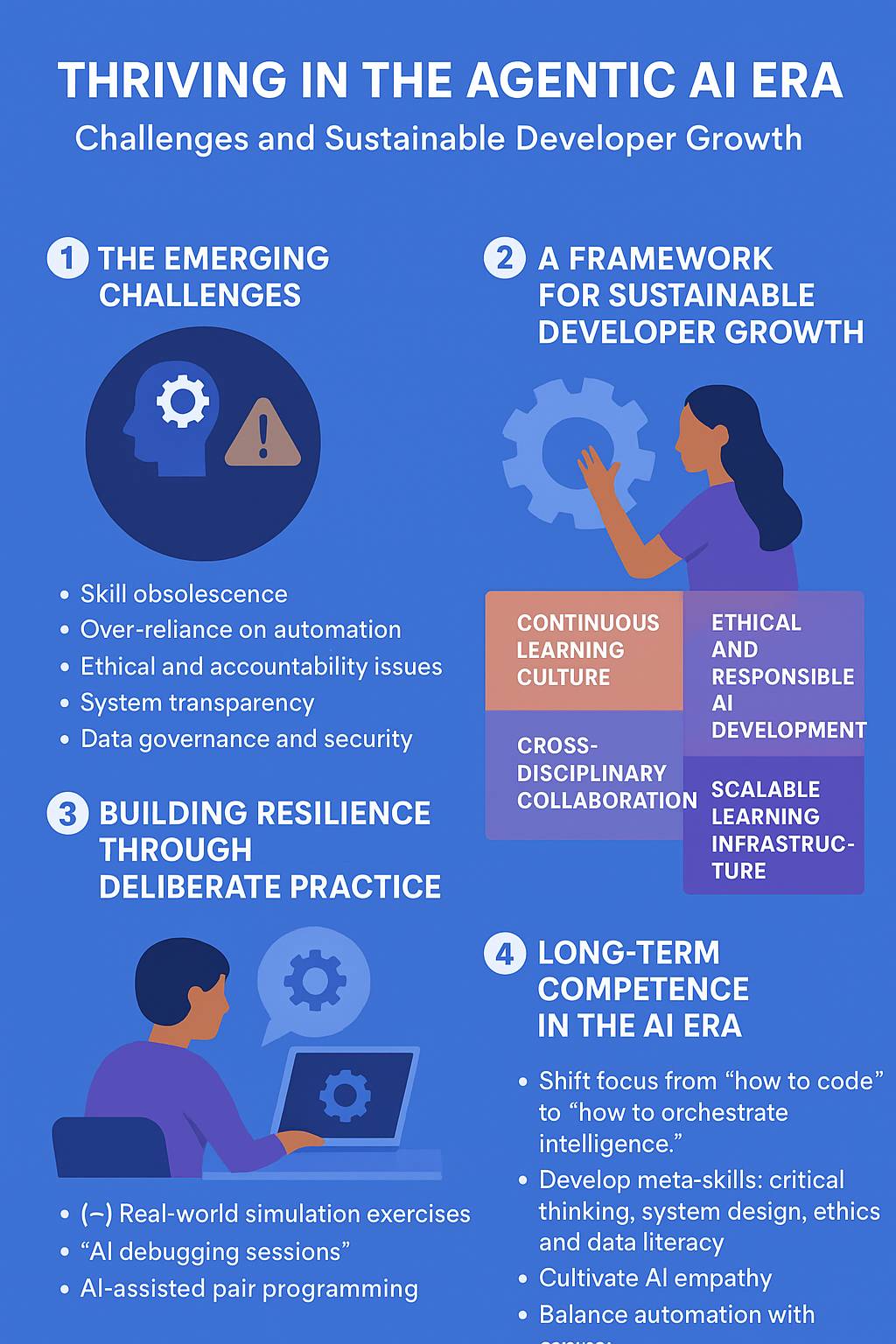
Agentic AI is redefining what it means to build, manage, and scale technology.
Developers who embrace continuous learning, ethical awareness, and adaptive collaboration will lead the next wave of digital innovation.
At Codea Technologies, we believe in empowering teams and businesses to harness the power of intelligent automation — responsibly and sustainably.
For more details
Get in Touch